

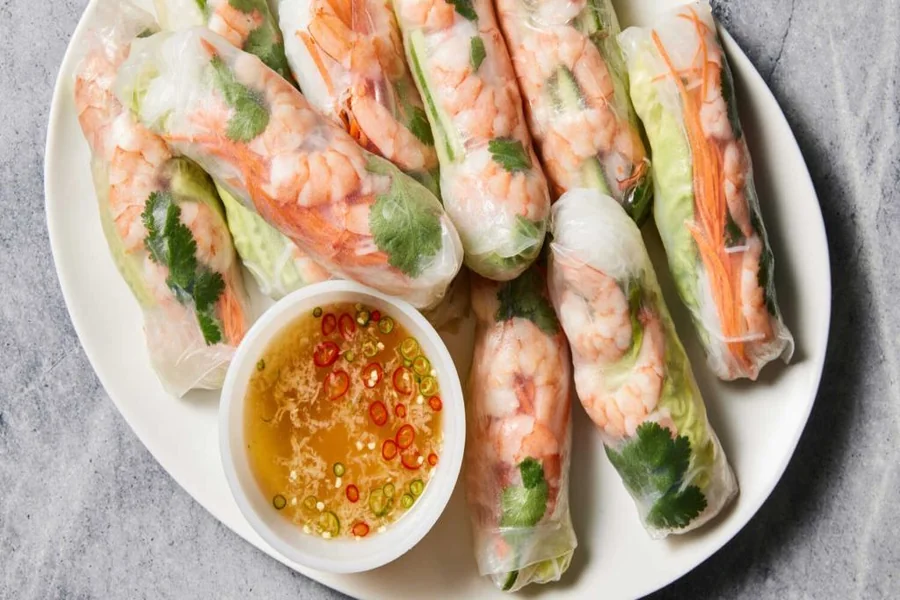
What Is Real Thai Rice Paper and Why It Stands Out
Real Thai Rice Paper is a traditional food item that consists primarily of rice flour, water, with occasional tapioca starch, prepared in a manner that reflects Thai culinary traditions. Real Thai Rice Paper is distinguished by its quality, texture and authenticity making it stand out of the mass-produced alternatives.
Authentic Thai rice paper has a more balanced softness and strength in wetting, unlike generic versions. It does not tear easily and is thus important in wrapping fragile fillings. This renders it suitable both to the novice and the accomplished cook.
The other reason as to why it is unique is because it is associated with traditional cooking. Rice paper has been a tried and true ingredient in street food and kitchens in Thailand and adjacent areas. It is prepared and used heavily as a cultural phenomenon and as such it has an identity more than a mere wrap.
Thai Real Rice Paper Making
Preparation of Thai rice paper in real is an easy yet skillful and precise task. It begins with a blend of rice flour and water with or without tapioca starch to enhance elasticity. This is a blend that is smeared in thin layers and steamed on a level.
The sheets are then steamed and then laid to dry. They are traditionally dried in the sun, contributing to the achievement of the appropriate texture. This natural dry process helps in the slightly hard and yet flexible structure of the final product.
When dried the sheets become brittle and hard. But when wet in water they change, and become soft and pliable. This is what makes them so versatile in the preparation.
The old approach is more on quality than speed and this is the reason why the traditional Thai rice paper can feel better than the cheaper, factory-made ones.
Real Thai Rice Paper types
There are various forms of real Thai rice paper each of which is used to suit various cooking styles. Knowing the types will assist you in selecting the right one to meet your needs.
Most common are thin sheets of rice paper. They are applied to fresh wraps and rolls. These wrappers become soft easily and they are simple to work with and so suitable in cooking light meals.
The frying is done in thicker rice paper. They are stronger sheets, and can support heavier fillings. Fried, they are crisp and golden, with an entirely different texture.
Other minor additions such as sesame seeds are used in some varieties. These not only add flavor, but also visual appeal. Although this is not necessary, they may give your food a special flavor.
The correct type is determined by the way you intend to use it. Fresh foods go well in thin sheets whereas cooked or fried foods go well in thicker sheets.
The use of Real Thai Rice Paper in Cooking
Real Thai rice paper is easy to use, though a few steps can be used to achieve the best results. Begin by making all your ingredients ready, then work with the sheets. When softened, they must be utilized as soon as possible.
Moisten the rice paper in a little lukewarm water. It ought to be tender and not too weak. Set it on a clean, flat surface, and fill it in the middle with your fillings.
The bottom edge should be folded over the filling, and then the sides and rolled inwards. This makes a nice and safe wrap. Do not overfill since this will make it hard to roll and may tear.
Thai rice paper is available in the real form and can be used in numerous ways. The most popular is fresh roll, although it can also be fried or baked to have varying textures. You can be creative with recipes with its flexibility.
Nutrition and Health
Thai rice paper is normally low in fat and calories and thus a light meal. It is primarily a source of carbohydrates which act as a source of energy.
It is normally gluten-free, making it appropriate to individuals who are sensitive to gluten. This contributes to its attractiveness as a diet friendly ingredient.
Nonetheless, it does not include large portions of protein and fiber. In order to have a balanced meal, this should be coupled with vegetables, lean proteins, and healthy fats.
The nutrition of food prepared using rice paper is mostly determined by the fillings and cooking techniques. New preparations are healthier as compared to fried ones.
In general, it can be a component of a healthy diet when consumed in moderation.
Guidelines to Selecting genuine Thai Rice Paper
When selecting real Thai rice paper, it is important to take a few details into consideration. The first one is to examine the ingredient list. Counterfeits tend to contain unnecessarily added components in their products.
Search: Find some sheets that are of similar shape and are not too brittle. A good quality rice paper must not be easily broken.
Clues can also be given by packing. The products that have clear labeling of origin and traditional names are likely to be more trustworthy.
Whenever you can, experiment with the various brands in order to discover the one that you like the most. The texture and thickness may change and taste also contributes in choosing the most appropriate one.
It is also important to store it properly. Store it in a dry environment and after opening it well sealed to preserve quality.
Typical errors in working with Thai Rice Paper
Despite the quality of rice paper, errors are able to impact your work. Over-soaking is one of the common problems. When the sheet is left in water too long it becomes too soft and hard to work with.
Excessive filling is another error. This may result in tearing and rolling messy. It is important to maintain the filling in equilibrium.
The sheet may also be damaged in case handled roughly. Light movements and good technique are used to preserve its form.
Sticking may occur with a dry surface. A moderately wet surface is more effective to roll.
By preventing such errors, you can create better dishes and experience the full benefits of authentic Thai rice paper.
Final Thought
Thai rice paper is not just a mere wrap. It is the symbol of tradition, quality, and versatility in cooking. It is simple to use and flexible, so it can be used on a variety of dishes, including fresh rolls and crispy snacks. It is possible to prepare dishes which are both delicious and authentic by learning about its types, how to prepare it and how to handle it. It can be an effective addition to your kitchen with some practice.
FAQs
What is real Thai rice paper made of?
Real Thai rice paper is made from rice flour, water, and sometimes tapioca starch.
Is real Thai rice paper different from regular rice paper?
Yes, it often has better texture and quality due to traditional preparation methods.
Do you need to cook real Thai rice paper?
No, it only needs to be soaked briefly in water before use.
Can real Thai rice paper be fried?
Yes, thicker types can be fried to create a crispy texture.
Is real Thai rice paper healthy?
It is low in fat and calories, but its overall health value depends on the fillings used.
How do you store real Thai rice paper?
Store it in a cool, dry place in an airtight container.
Why does real Thai rice paper tear easily?
It may tear if over-soaked or handled too roughly during preparation.
